
Kiowa County Case Search Filters
One clerk, one courthouse, two trial courts. A Kiowa County case search has to hit the right layer. Otherwise the result stays hidden even when the file is public. District Court handles the heavier caseload. That means CR felonies, CV civil claims, DR domestic relations, PR probate, juvenile matters, and other general-jurisdiction cases. County Court takes M misdemeanors, T traffic, C civil suits, S small claims, infractions, and preliminary felony stages. Pick the wrong court or class code and the docket simply will not surface.
The 15th Judicial District filter trims a regional system. That system also covers Baca, Cheyenne, and Prowers counties. Add Kiowa County and the court type whenever you know it. Some felonies start as a County Court complaint. They later open as a District Court CR case, so search both case numbers instead of squeezing the whole history into one lookup.
Name-Based Case Searches
Start with the free Colorado Judicial Branch Docket Search. It matches a person, a business, or an attorney with a hearing on the calendar. Choose Kiowa County, set a date, then add at least one more filter. A bare last name floods you with namesakes. Businesses belong in business mode. Attorneys can be found by name or Colorado registration number. Remember that these hits are calendar entries only, not complete case histories.
Need the full register of actions in order? Use Colorado Courts Record Search / CoCourts or another vendor the Judicial Branch lists. It searches by name or case number. It charges a fee. The data updates in real time. But the state cautions that it is unofficial, may hold errors, skips some case types, and shows no images of filed documents.
- Choose a date or date range in the free state docket form.
- Select Kiowa County, then choose individual, business, or attorney mode.
- Add the clearest known name, court type, or case class.
- Compare the full case number, court, and hearing type before treating a line as a match.
- Use CoCourts for chronology or ask the clerk for the actual case file.
| Field Label | Type | Required | Notes |
|---|---|---|---|
| Date Range | Date | Yes | The free form also requires one non-date filter. |
| County | Dropdown | One valid filter | Select Kiowa County for local state-court settings. |
| First / Last Name | Text | No | Used in individual mode; verify namesakes by case number. |
| Business Name | Text | No | Used instead of individual-name fields. |
| Attorney | Name or number | No | Search by counsel name or bar number. |
Choose the Kiowa County Search Layer
Three tools, three questions. The free docket tells you when a proceeding is set. The fee vendor tells you which events sit in the register of actions. The Clerk of Court, Kiowa County Combined Court tells you what a filed order or pleading actually says. That office can issue a certified copy. Most failed Kiowa County case searches start in the wrong layer. It was simply the wrong layer for the question being asked.
Match the tool to the need: use the calendar for dates, the register for chronology, and the clerk for documents or an official record.
The Judicial Branch A-Z directory collects its services in one place: records requests, transcript tools, sealed-case resources, and payment paths. The official directory view also makes clear which of those services is separate from the hearing calendar itself.
That directory only routes requests. Before anything goes out, pin down the exact Kiowa County court, the full case number, and the specific record wanted.
Kiowa County Printable Docket Results
Colorado's free docket search lets you export or print what it returns. A Kiowa County line on that calendar shows the date and time, how long the hearing runs, the party or case-style name, and the full case number. It also lists the hearing type, its location, the appearance type, and the courtroom. Keeping a printout can be worth it. It preserves what the calendar said at the moment of your docket search.
Treat that printout as a snapshot only. A calendar line is not the register of actions, not the filed notice, and not a certified court record. Before the setting, run the live docket again. Hold on to the case-specific notice. Call the clerk whenever a continuance or a blank appearance field leaves the current instruction unclear.
Case Number Searches
Every Colorado case number stitches together three things. Those are the filing year, letters for the case class, and a sequence. The letters tell you where to look. CR means District Court criminal, M is County Court misdemeanor, T is traffic, CV is District Court civil, C is County Court civil, S covers small claims, DR is domestic relations, and PR is probate. Some forms lay those parts out in separate boxes. A compact one reads like 2026CR123.
Feed the portal whatever segments it asks for, exactly as asked. A felony often starts life as a County Court complaint. It only later picks up a District Court CR number. Search both numbers if you follow that path. One number does not travel with a case through every court level. An appeal opens a fresh docket. The trial court's register keeps logging its own notice and record events.
Kiowa County Register Search Coverage
CoCourts register data reaches civil, civil water, small claims, domestic, felony, misdemeanor, and traffic case histories flowing through the state's vendor system. It takes a name or case number as a search key and charges a fee. The on-screen controls and price shift over time. Trust the vendor's current screen over any older quoted amount.
Coverage has gaps, though. The Judicial Branch cautions that vendor results can skip whole cases or case types. They can carry errors and stay unofficial even with data distributed in real time. Sealed and protected matters answer to separate rules. If the Kiowa County register leaves out a file you know is public, hand the clerk the court, class, year, and sequence, and ask which search or request route fits.
When Kiowa County Search Returns Nothing
A blank screen is not a final answer. Kiowa County dockets hide cases for many reasons. The date window may miss the next setting. Or the name may be spelled differently in the file. A matter can also sit in District Court rather than County Court. It may carry a different class, be too old for the public index, or be restricted by law. Thin weekly results may simply reflect Kiowa County's small court volume. So a blank docket search does not mean a broken one. The official Kiowa County court page is the local state-court starting point.
Work the angles before giving up. Search by case number, widen the dates, switch court type, and reread the case notice. Then call the clerk at the Kiowa County Combined Court, 719-931-6010, during the published Monday through Thursday hours. Ask whether clerk assistance, an older-file search, or a controlled access process applies. A blank screen never proves sealing.
For context, the Judicial Branch data and reports publish statewide caseload figures by county. They offer no person-level lookup.
Those reports explain filing volume across counties, but no report replaces the live docket, the register, or the clerk-held record itself.
Note: Count cases by unique case number because one matter can produce more than one displayed name line.
Case Search Results Explained
The free result points at a scheduled event. It lists the date, start time, duration, displayed name or case-style element, full case number, hearing type, location, appearance type, and courtroom. Nothing deeper comes through. Pleadings, charge detail, judgment image, ledger, and certification stay out. The fee register reaches deeper into the chronology. Yet it still does not supply the paper behind an entry.
| Case Number | Year, class, and sequence, such as 2026T123. |
|---|---|
| Hearing | Date, time, duration, and type of scheduled event. |
| Location | Kiowa County court location and assigned courtroom or division. |
| Appearance | Stated appearance type; a blank field is not remote permission. |
| Missing Detail | No full event history, filed document image, or certified record. |
Trust the newest valid setting and the written order. An older setting can remain a true historic event after a continuance, while the current calendar shows the new date.
Kiowa County Appeals Use New Dockets
A Kiowa County docket does not follow a case upward. Most District Court appeals move to the Colorado Court of Appeals. Discretionary review can reach the Colorado Supreme Court. County Court appeals usually land in District Court. Each reviewing court keeps its own docket.
The official Court of Appeals page shows the state appellate layer.
The trial register may note a notice of appeal. Briefs, orders, and settings live on the appellate docket.
The Colorado Supreme Court page names the state's highest court and its public resources.
Follow the tribunal named on the appeal notice. A Kiowa County result will not hold the whole review.
Two Ways to Search: County and State
Kiowa County runs no separate local case portal. Its state trial courts sit on statewide systems, while the Combined Court clerk handles local confirmation and documents. Filter the free state docket to Kiowa County. CoCourts adds participating Colorado register data. For an order, decree, disposition, or certified copy, the clerk stays the authoritative local source.
| Search Path | Best Use | Main Limit |
|---|---|---|
| Colorado docket search | Free Kiowa County hearing lookup | Calendar only |
| CoCourts | Name or number register search | Fee, unofficial, no document images |
| Combined Court clerk | Inspection, copies, current confirmation | Contact during local service hours |
| Online record request | Known filing, order, or certified copy | Fees and access limits may apply |
The next step is paperwork. Once a docket search lands the right matter, the Kiowa County court case records resource walks through the document request process.
Federal Cases Leave Kiowa County Search
Federal cases live outside this docket. Civil, criminal, and bankruptcy matters from federal court never appear in the Kiowa County state-court docket. The U.S. District Court for the District of Colorado uses PACER for federal docket sheets and documents. PACER needs an account. It charges 10 cents per page, generally caps one document at $3, and waives fees when quarterly use is $30 or less, subject to its current rules.
The official PACER service is the federal starting point.
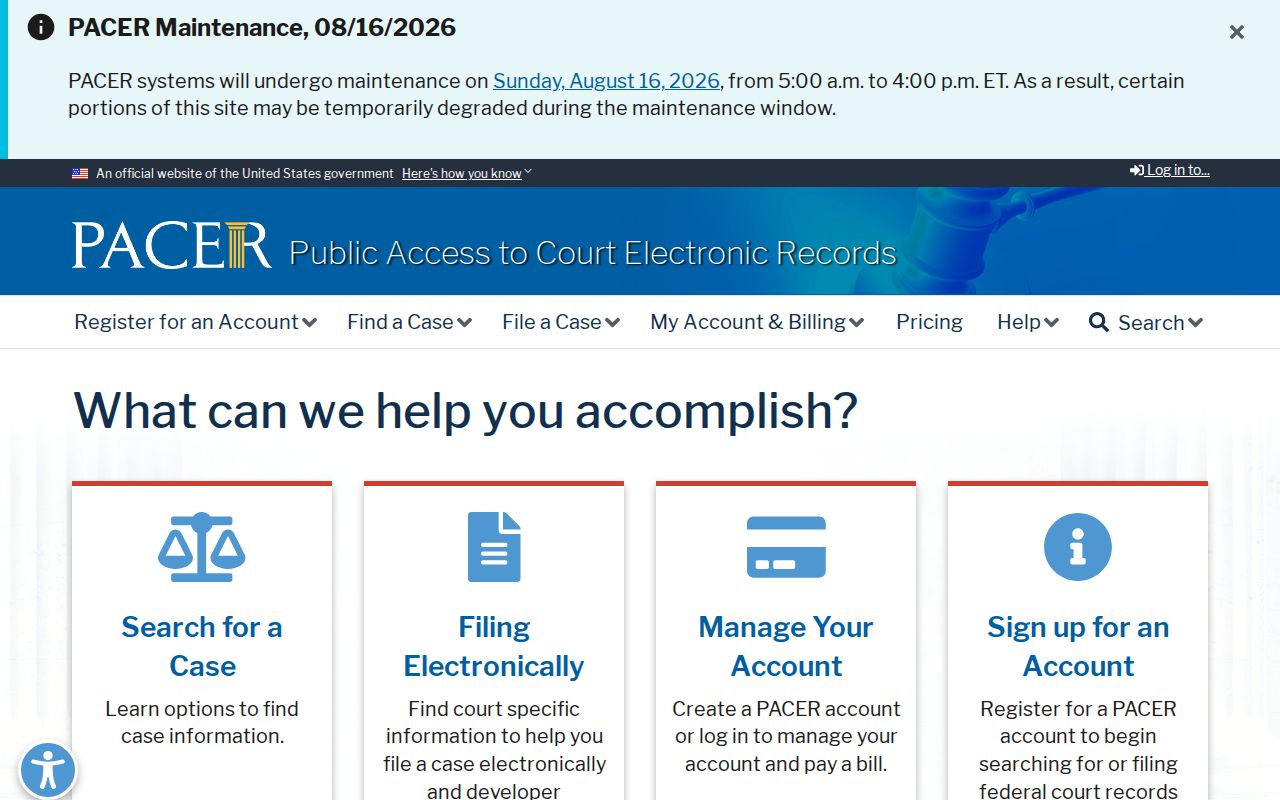
PACER entries link straight to filed federal documents, something the Colorado fee vendor's state register cannot do. The official fee explanation lists billing and waiver rules.
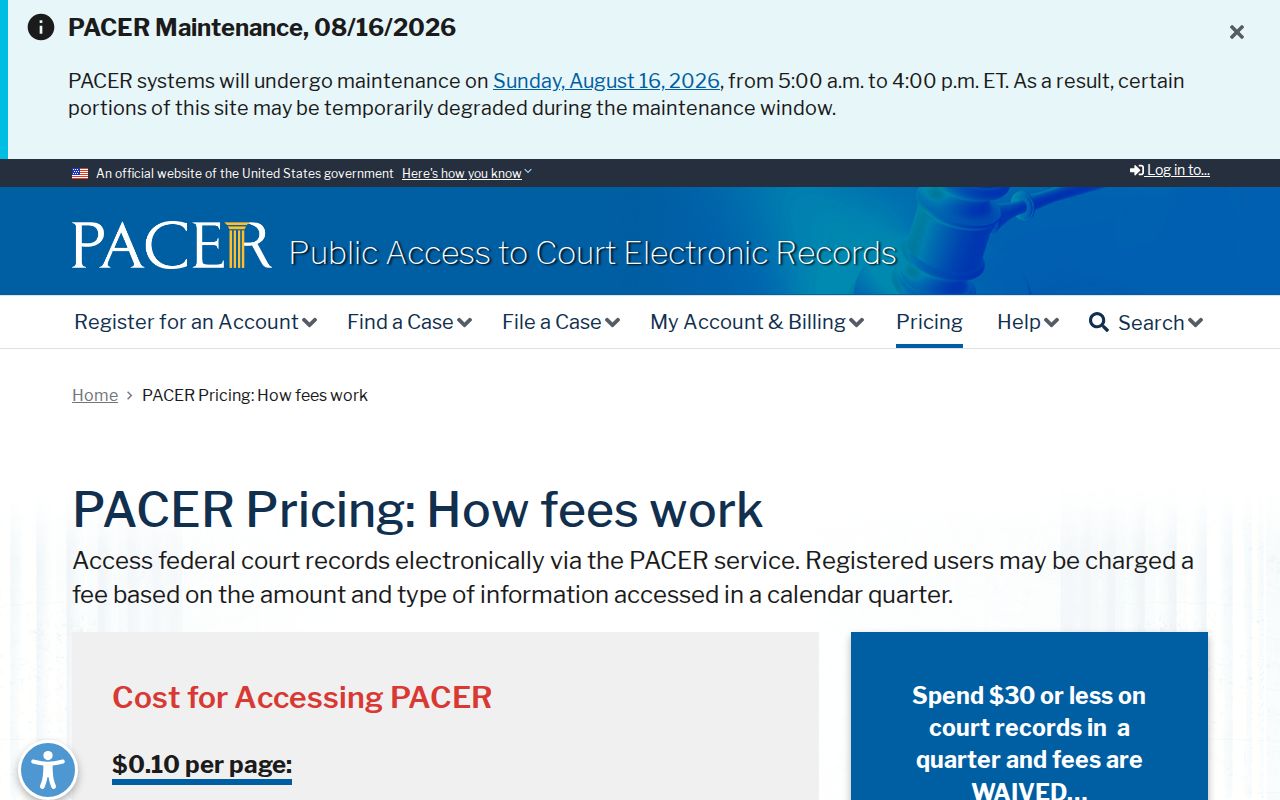
Check the fee page before any big download of a long docket or a large set of documents.
Which Cases Stay Restricted
Colorado access rules wall off sealed or expunged cases. They also limit many juvenile, adoption, dependency, paternity, truancy, mental-health, and judicial-bypass matters from ordinary searches. Some domestic-relations and probate files get tighter treatment. A register may stay public while one document is sealed, or an entire case may be absent. Sensitive identifiers and reports get redacted or withheld.
A case number is not a key. It cannot override a court order or a security level. Parties and others with legal authority should use the Judicial Branch sealed-case process and ask the clerk about controlled access. E-filing labels carry meaning. Public, Protected, Restricted, Suppressed, and Sealed are distinct security levels, and they decide who sees a document, not whether a curious searcher can slip past the rule.
From Kiowa County Search to Filing
A register entry can name an order or motion yet still not show you the document itself. Write down the case number. Note the entry's exact title and its filing date too. With those details, you can submit the Judicial Branch record request. Or simply contact the clerk for a copy. The Kiowa County staff directory points you to the local clerk operation. On the statewide form, you check off the record type you need. That may be civil, criminal, family, probate, register, or another category. You can also ask for a certified or exemplified copy on the same form.
Colorado Courts E-Filing works differently. It serves authorized users who file and serve documents. So it is not an open Kiowa County docket search. Approved vendors may receive public case data. But document copies for the public still come from the court. Keep that line clear. A search result is never the filed paper, and it is not an official certified record.
Older Kiowa County files raise one more question. Is the file stored off site, and does retrieval cost extra? Ask before you commit. The clerk may also quote research or redaction time if a broad request needs staff review. A precise document name and entry date narrows that work considerably. The current statewide request form sets an ordinary response target of three business days. Some extenuating circumstance can delay the search.